Skip to content
Bellman+ Associates

Medicare 101

Medicare Doesn't Have to Feel Overwhelming.

Medicare has several parts, coverage options, enrollment periods, and rules that can affect the choices you make. Understanding how these pieces work together can help you make more informed decisions about your healthcare coverage.

Below is an overview of some of the most important Medicare topics. For additional guidance, visit our Resources Center for educational guides, checklists, and Medicare planning tools.

The foundation

Original Medicare

Original Medicare consists of Medicare Part A and Medicare Part B. It is administered by the federal government and provides coverage for many hospital and medical services.

Medicare Part A — Hospital Insurance

Part A generally helps cover:

  • Inpatient hospital care
  • Skilled nursing facility care following a qualifying inpatient hospital stay
  • Hospice care
  • Certain home health services

Many people qualify for premium-free Part A based on their own or a spouse's work history. However, deductibles and other cost-sharing may apply.
Medicare Part B — Medical Insurance

Part B generally helps cover:

  • Physician and specialist services
  • Outpatient care
  • Preventive services
  • Diagnostic testing and lab services
  • Durable medical equipment
  • Certain home health services
  • Some medications administered in a physician's office or other outpatient setting

Part B typically requires a monthly premium. A deductible and coinsurance may also apply.

With Original Medicare, you can generally see any doctor or healthcare provider in the United States who accepts Medicare. Original Medicare does not have an annual out-of-pocket maximum for Part A and Part B services.

Because Original Medicare does not cover everything, beneficiaries may also consider separate Medicare Supplement (Medigap) coverage and Part D prescription drug coverage.

Understanding Medicare Parts A & B

Another coverage path

Medicare Advantage — Part C

Medicare Advantage, also called Medicare Part C, is another way to receive your Medicare Part A and Part B benefits.

Medicare Advantage plans are offered by private insurance companies approved by Medicare. You must have Medicare Parts A and B to enroll and must continue paying your Medicare Part B premium.

Plans may include:

  • Hospital and medical coverage
  • Prescription drug coverage in many plans
  • An annual maximum out-of-pocket limit for covered Part A and Part B services
  • Additional benefits not covered by Original Medicare, which may include dental, vision, hearing, fitness or other benefits depending on the specific plan.

Medicare Advantage plans may use provider networks. Depending on the type of plan, such as an HMO or PPO, the doctors, hospitals, pharmacies, and other providers you use can affect your coverage and costs.

Plans can also have deductibles, copayments and coinsurance for various services. Premiums, benefits, networks, formularies and cost-sharing vary by plan and can change from year to year.

This is why evaluating a Medicare Advantage plan involves more than looking at the monthly premium. Your healthcare providers, prescriptions, preferred pharmacies, expected healthcare needs, plan rules, and potential out-of-pocket costs should all be considered.

Medicare Advantage: What to Consider Beyond the Premium

Supplementing Original Medicare

Medicare Supplement / Medigap

Medicare Supplement Insurance, commonly called Medigap, works alongside Original Medicare.

Medigap policies are sold by private insurance companies and are designed to help pay certain out-of-pocket costs that Original Medicare does not pay, such as deductibles, copayments and coinsurance, depending on the Medigap plan selected.

With a Medigap policy, Original Medicare remains your primary coverage. In most cases, you can see any healthcare provider nationwide who accepts Medicare.

Medigap is different from Medicare Advantage.

A Medicare Advantage plan provides your Medicare Part A and Part B benefits through a private Medicare-approved plan. A Medigap policy supplements Original Medicare rather than replacing how you receive your Original Medicare benefits.

Medigap policies sold to people newly eligible for Medicare do not include outpatient prescription drug coverage. If you choose Original Medicare with a Medigap policy and want prescription coverage, you generally need a separate Medicare Part D plan.

Medigap premiums vary by insurance company, location, plan and other factors permitted under applicable rules. Your rights to purchase a Medigap policy can also depend on when you apply, making enrollment timing especially important.

Medicare Supplement vs. Medicare Advantage

Prescription coverage

Prescription Drug Coverage — Part D

Medicare Part D helps cover outpatient prescription medications.

Part D coverage is available through private insurance companies approved by Medicare. It may be purchased as a stand-alone Prescription Drug Plan for someone using Original Medicare, or prescription coverage may be included in a Medicare Advantage plan.

Every Part D plan has a formulary, which is the plan's list of covered medications. Covered drugs may be placed into different tiers with different cost-sharing requirements.

When evaluating prescription drug coverage, it is important to consider:

  • Your specific medications
  • Dosage and frequency
  • The plan's formulary
  • Drug tiers
  • Copays or coinsurance
  • Deductibles
  • Preferred and in-network pharmacies
  • Prior authorization, step therapy or quantity limits that may apply.

Two people living in the same ZIP code may have very different prescription costs under the same plan simply because they take different medications or use different pharmacies.

That is why an accurate, up-to-date medication list is an important part of a Medicare plan review.

Preparing Your Prescription List for a Medicare Review

Medicare and employment

Working Past 65

Turning 65 does not automatically mean that everyone should enroll in every part of Medicare immediately.

If you or your spouse are still working and you have employer-sponsored health coverage, the timing of Medicare enrollment can depend on several factors, including the type of coverage you have and the size of the employer.

Before delaying Medicare Part B, it is important to understand whether your current coverage allows you to qualify for a Special Enrollment Period later without a late-enrollment penalty.

Retiree coverage, COBRA, Marketplace coverage and certain other types of insurance do not necessarily provide the same Medicare enrollment protections as coverage based on current employment.

HSA Considerations

Medicare and Health Savings Accounts require additional planning.

Once you are enrolled in Medicare, you can no longer contribute to an HSA. In addition, Medicare Part A coverage can sometimes be retroactive when someone enrolls after age 65, which can affect HSA contributions.

If you are approaching 65 and plan to continue working, understanding these rules before enrolling in Medicare or claiming Social Security can help you avoid enrollment and HSA mistakes.

Working Beyond 65: Medicare & Employer Coverage Checklist

Timing matters

Medicare Enrollment Periods

Medicare has specific enrollment periods, and the rules are different depending on your circumstances.

Initial Enrollment Period — IEP

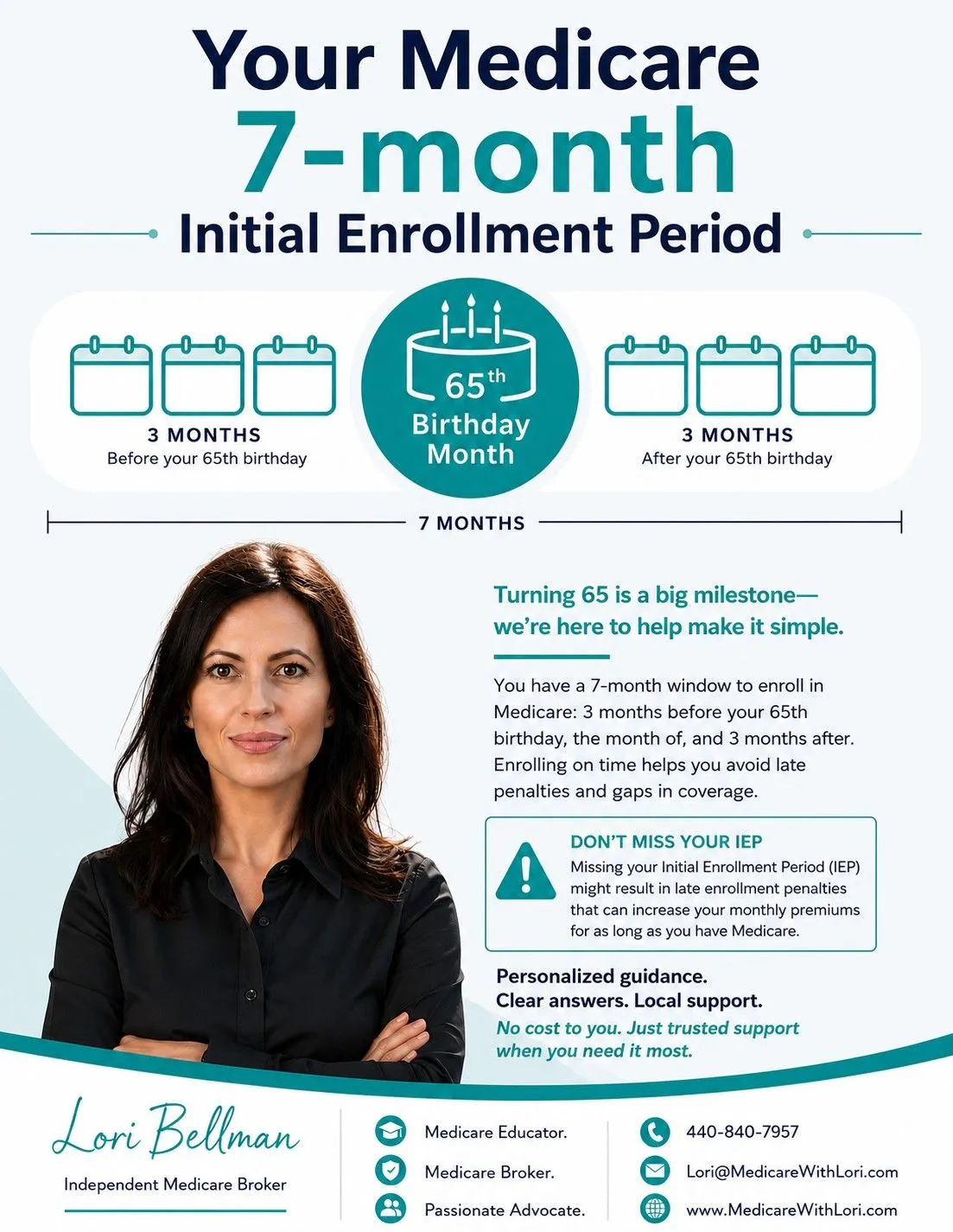
For most people, the Initial Enrollment Period is the seven-month period surrounding their 65th birthday — beginning three months before the month they turn 65, including their birthday month, and ending three months afterward.

Special Enrollment Period — SEP

Certain circumstances may provide a Special Enrollment Period. One common example is losing qualifying employer-sponsored coverage after working past 65.

Other qualifying events can also create Special Enrollment Periods, and the applicable timeframe and plan options depend on the specific event.

Annual Enrollment Period — AEP

The Medicare Annual Enrollment Period runs October 15 through December 7 each year.

During AEP, Medicare beneficiaries may generally make changes to their Medicare Advantage or Part D coverage for the following year.

Medicare Advantage Open Enrollment Period — OEP

The Medicare Advantage Open Enrollment Period runs January 1 through March 31.

It applies to people already enrolled in a Medicare Advantage plan and allows certain changes, including changing to another Medicare Advantage plan or returning to Original Medicare and, when applicable, joining a stand-alone Part D plan.

Other enrollment opportunities may apply based on circumstances such as moving, losing coverage, qualifying for certain assistance programs, or changes involving a Medicare plan.

Initial Enrollment Period infographic showing the seven-month window around a 65th birthday
Medicare Enrollment Periods at a Glance

Income and premiums

IRMAA

IRMAA is an additional amount some higher-income Medicare beneficiaries pay for Medicare Part B and Part D.

The Social Security Administration generally determines whether IRMAA applies using income information reported to the IRS, typically from two years prior.

One of the most important things to understand about IRMAA is:

IRMAA is separate from the Medicare Advantage, Medicare Supplement, or prescription drug plan you choose.

Changing from one Medicare plan to another does not, by itself, eliminate an IRMAA adjustment.

Certain life-changing events — such as retirement, marriage, divorce, death of a spouse, loss of income-producing property, loss of pension income or an employer settlement payment — may allow someone to request a new IRMAA determination when their income has decreased.

Understanding IRMAA & Medicare Premiums

A short glossary

Medicare Terminology

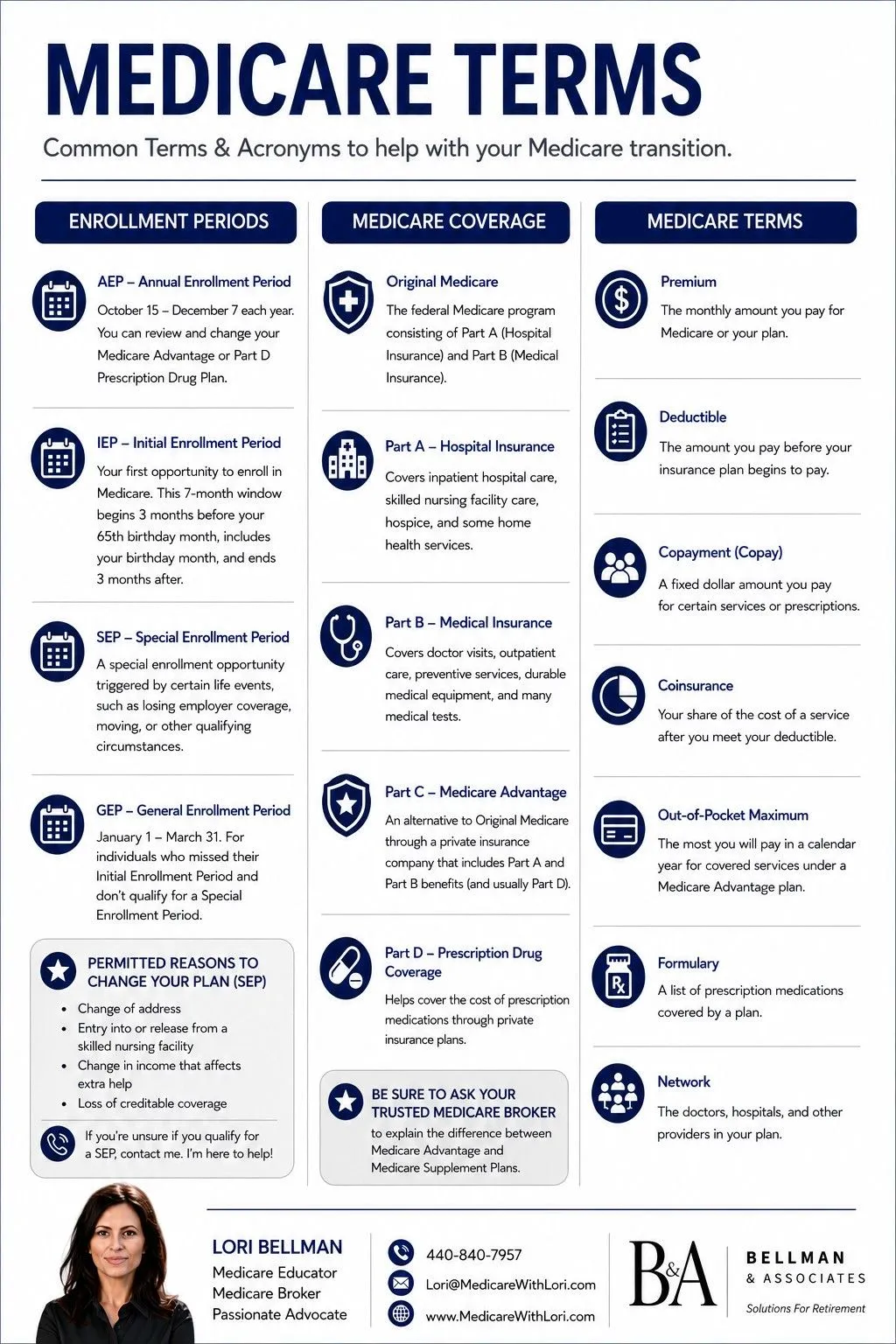
Medicare terms glossary infographic
Deductible
The amount you may be required to pay for covered healthcare or prescription drugs before certain plan benefits begin paying.
Copayment — Copay
A fixed dollar amount you pay for a covered service or medication, such as $20 for an office visit.
Coinsurance
A percentage of the cost of a covered healthcare service that you are responsible for paying.
Maximum Out-of-Pocket — MOOP
The most you pay during the plan year for covered Part A and Part B services under a Medicare Advantage plan, subject to the plan's rules. Prescription drug costs are handled separately under Part D rules.
Formulary
The list of prescription medications covered by a Part D or Medicare Advantage prescription drug plan.
Network
The doctors, hospitals, pharmacies and other healthcare providers that contract with a particular health plan.
Prior Authorization
A plan requirement that approval be obtained before certain services, procedures or medications will be covered.
Step Therapy
A prescription drug utilization-management requirement that may require trying another covered medication before the plan covers a particular drug.
Quantity Limit
A plan rule limiting how much of a particular medication will be covered during a specified period.
Premium
The amount you pay for coverage, usually monthly. Medicare beneficiaries may have separate premiums for Part B, Part D, Medicare Advantage or Medigap coverage depending on their choices and circumstances.
Medicare Terms Made Simple

Medicare is personal

There is no single Medicare coverage choice that is right for everyone.

Your doctors, prescriptions, preferred hospitals and pharmacies, healthcare needs, budget, travel habits, employer coverage and personal preferences can all influence which coverage options you may want to consider.

Our approach begins with education and understanding your individual needs — so you can make an informed Medicare decision with greater confidence.

Have Questions About Your Medicare Options?

Schedule a complimentary Medicare Review to discuss your needs, questions and available coverage options.

A good next step

Ready to talk about what Medicare looks like for you?

Schedule Your Medicare Review